What was going wrong
The agency had outgrown its patchwork of tools. Each account manager tracked clients their own way. Work went out over email and chat with no single latest version, so when a client pushed back, approvals came down to who remembered what.
Money lived in spreadsheets: invoices, payment requests, and partner commissions, none of it tied to the work that earned it. Leave and work-from-home were another thread again. Every gap was a place for work to get lost, and the founder was the backup memory for all of it.
What I did
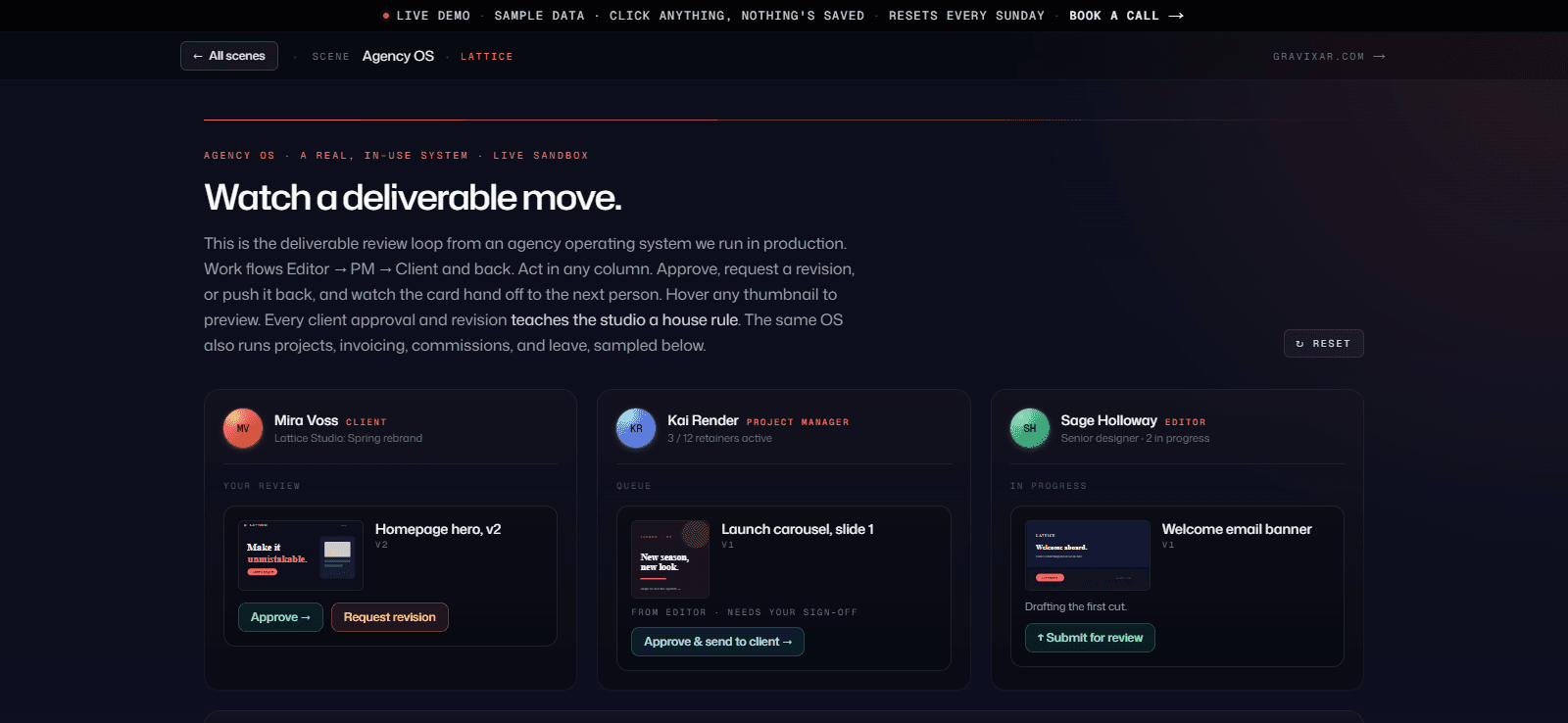
I built one portal where each person sees only what their role needs, with a fixed set of steps at the center. Each account manager gets their own workflow and their own clients. Clients log in to see only their projects, and a real approval flow: a deliverable is submitted, reviewed inside the agency, then sent to the client to approve. Every version is kept, and a recall pulls back a draft that went out too early.
The finance side ties money to the work: invoices, payment requests, partner and referral commissions, and revenue tracking, in the same system that holds the deliverables. Leave and work-from-home run alongside.
The team raises issues inside the app, and Claude sorts them first, so the founder opens an ordered queue instead of a pile. Everyone signs in with a second check, and files are kept in low-cost cloud storage.
What changed
Live and used every day by the agency's team, and the people who work in it have given strong feedback. The agency has even shown it to one of their own prospective clients as proof of how they run.
It is built on the same approval flow, record-keeping, and finance core as the rest of my work, fitted to how this team actually delivers. The next agency starts from this shape, and I cut or extend it to fit.
What's running today
The portal carries the whole agency, and what you see depends on who you are. An account manager sees their own clients and their own workflow. A client sees only their projects, their deliverables, and the approval flow, nothing else. The founder sees across all of it.
Decisions I'd defend
Feedback gets AI sorting, not AI answers. The AI orders the work. A person still decides what happens to it. That line does not move.
Access by role, and a second sign-in check, from day one. This portal holds client work and the agency's money. The permissions and the second check were not added later. They are how it shipped.
Files live on Wasabi. Cheap, portable cloud storage keeps large files affordable and out of the app's database, where they do not belong.
What's next
It is live and the agency runs on it. The roadmap is the agency's now: shape the parts to where their delivery is heading, not a rebuild. If your agency's patchwork of tools is costing more than it saves, tell me how it works today. The same shape can be fitted to how your team actually works.